01. B2B Marketplace
From Digital Presence to a Connected B2B Marketplace
Rebuilding a B2B marketplace journey from the data up: intelligent registration, a public catalogue for discovery, and one shared language of insights across services.
- Client
- B2B Marketplace
- Role
- Product Design Lead
- Sector
- Strategy · B2B marketplace
- Year
- 2026

Impact at a glance
01. Context
The customer journey review started with data quality. By identifying partners from their business domain and mapping the connections between companies and their domains, the platform could remove duplicates and put the right team members in the right organisation.
02. The problem
Even with cleaner data and a registration that identified organisations upfront, the value proposition stayed hidden behind the login. Customers only understood the portfolio after committing, and every service spoke a different analytical language.
Business goal
Turn the marketplace into a digital distribution channel that reduces friction and grows sales operations through integration with customer systems.
Customer goal
“Discover the portfolio, understand the synergies and feel in power before I decide.”
03. Insights
- 01
Data quality was the real first step of the journey: connecting companies to their domains removed duplicates and placed the right members in the right organisation.
- 02
A registration that identifies the organisation upfront turned a long form into a confirmation, and entering the marketplace became almost frictionless.
- 03
The value proposition was hidden after registration, so the discoverability phase had to move to the very beginning of the journey.
- 04
A public marketplace without prices could show service value, benefits, feature comparison and related services, so customers understand the portfolio and its synergies before taking a decision.
- 05
Different mental models per service overloaded customers. Templates reused across services created one analytics system where patterns are read at a glance.
04. Strategy
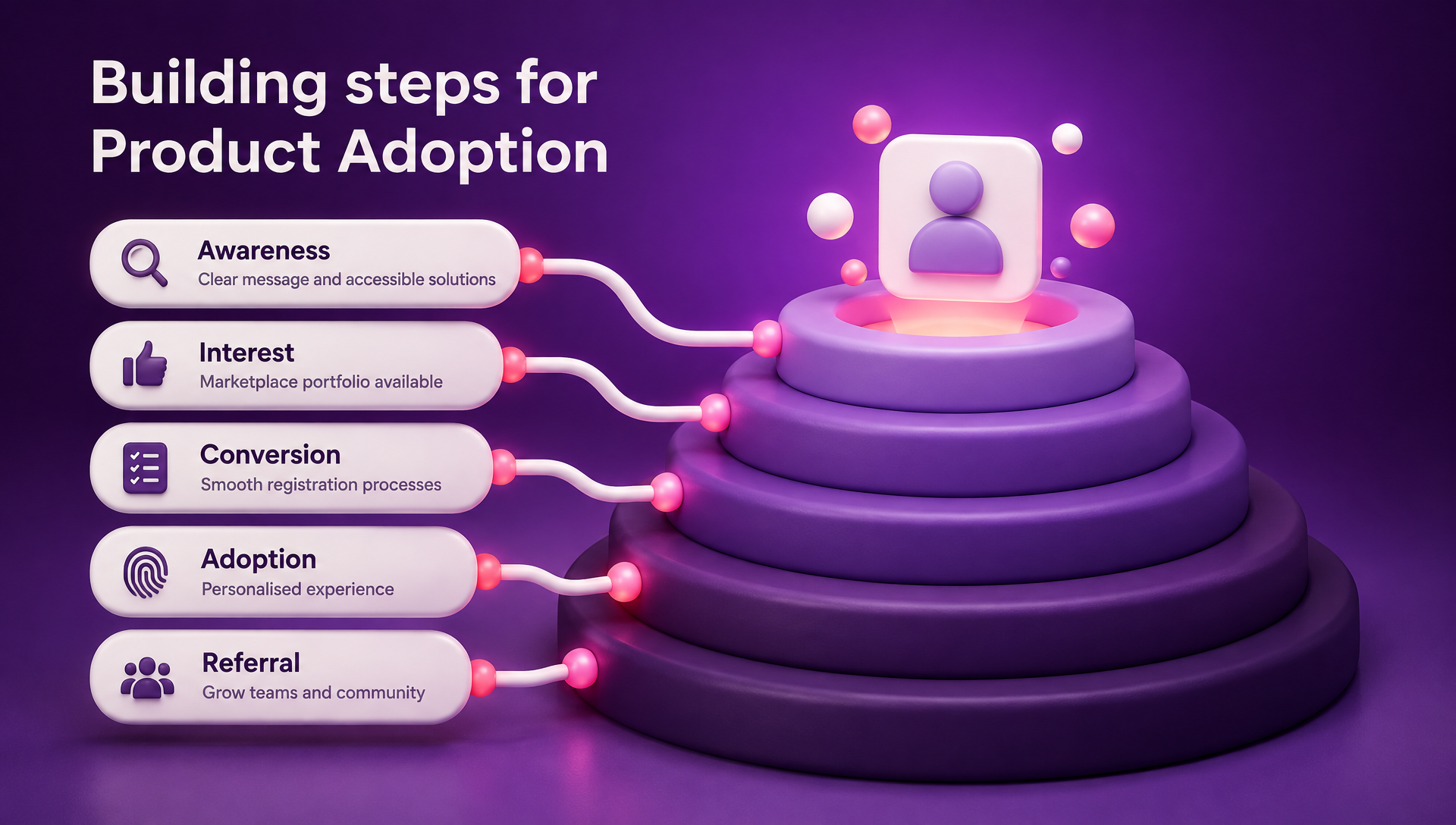
Identify
Fix the data foundation first: identify partners from their business domain, connect companies to domains, remove duplicates and grow membership with the right people in the right organisation.
Discover
A public marketplace without prices: service value, benefits, feature comparison and related services, plus deals, trials and demos, so discovery happens before any commitment.
Empower
A rebuilt dashboard with key insights in real time, in a consistent and shared language, so customers read patterns at a glance instead of learning a new mental model per service.
Connect
Templates reused across services and integration with customer systems, so the marketplace works as a distribution channel where tools connect to each other.
05. Key decisions
A public catalogue without prices
Trade-offLess direct monetisation upfront, far more discovery and understanding before commitment.
One analytics language instead of per service dashboards
Trade-offTemplates constrain each service's individuality, but customers learn once and read patterns at a glance.
Registration that identifies the organisation upfront
Trade-offIt depends on data quality work nobody sees, but it removes the friction everybody feels.
06. Outcome
A marketplace where people discover the portfolio, gain superpowers through tools that connect to each other, and network with partners, all built on clean data and one shared language of insights.
What I learned
“A marketplace is not a shop. It is a journey that starts with data quality and ends with customers feeling in power.”
Next case
Letting teams launch their own AI pipelines