05. CXA
Customer Experience Analytics
An analytics product where supervisors and managers see what customers talk about, how their mood shifts, and where teams need coaching or recognition.
- Client
- CXA
- Role
- Lead Product Designer
- Sector
- AI analytics · Customer experience
- Year
- 2025
Impact at a glance
01. Context
CXA is part of the AI suite: the transcriptions come from the pipelines teams configure in AI Launchpad, and the models behind them are monitored with AI Guardrails. On top of that foundation, supervisors and managers needed to understand what thousands of conversations actually mean for the business.
02. The problem
The signals were all there, buried in transcripts. Which topics dominate, which ones turn the mood sour, whether customers mention competitors, whether a change in conditions or a product launch landed well or badly. Without a clear read, coaching was guesswork and good teams went unnoticed.
Business goal
Give operations a clear, daily read of what needs to change, what needs improvement, and which teams should mentor the others.
Customer goal
“Open one screen and know what my customers feel, what my team needs, and where to act today.”
03. Insights
- 01
Supervisors think in topics and people, not in transcripts. The product had to aggregate first and let them drill down after.
- 02
Mood is the metric everyone understands. A shift from negative to positive is a story any manager can act on.
- 03
Every chart had to answer with evidence: one click from a bubble or a spike to the exact conversation behind it.
- 04
Recognition motivates as much as correction. Teams performing well had to be visible, so they could mentor others.
04. Strategy
Overview
A dashboard that opens with mood transitions and volume, so the health of the operation reads in seconds.
Explore
Topics and intents as living clusters, coloured by mood, with emerging intents surfaced before they become problems.
Evidence
Every insight links to the conversations behind it, with summaries and relevant moments, so decisions rest on real words.
Chapter 01 · Overview
The mood of the operation, at a glance
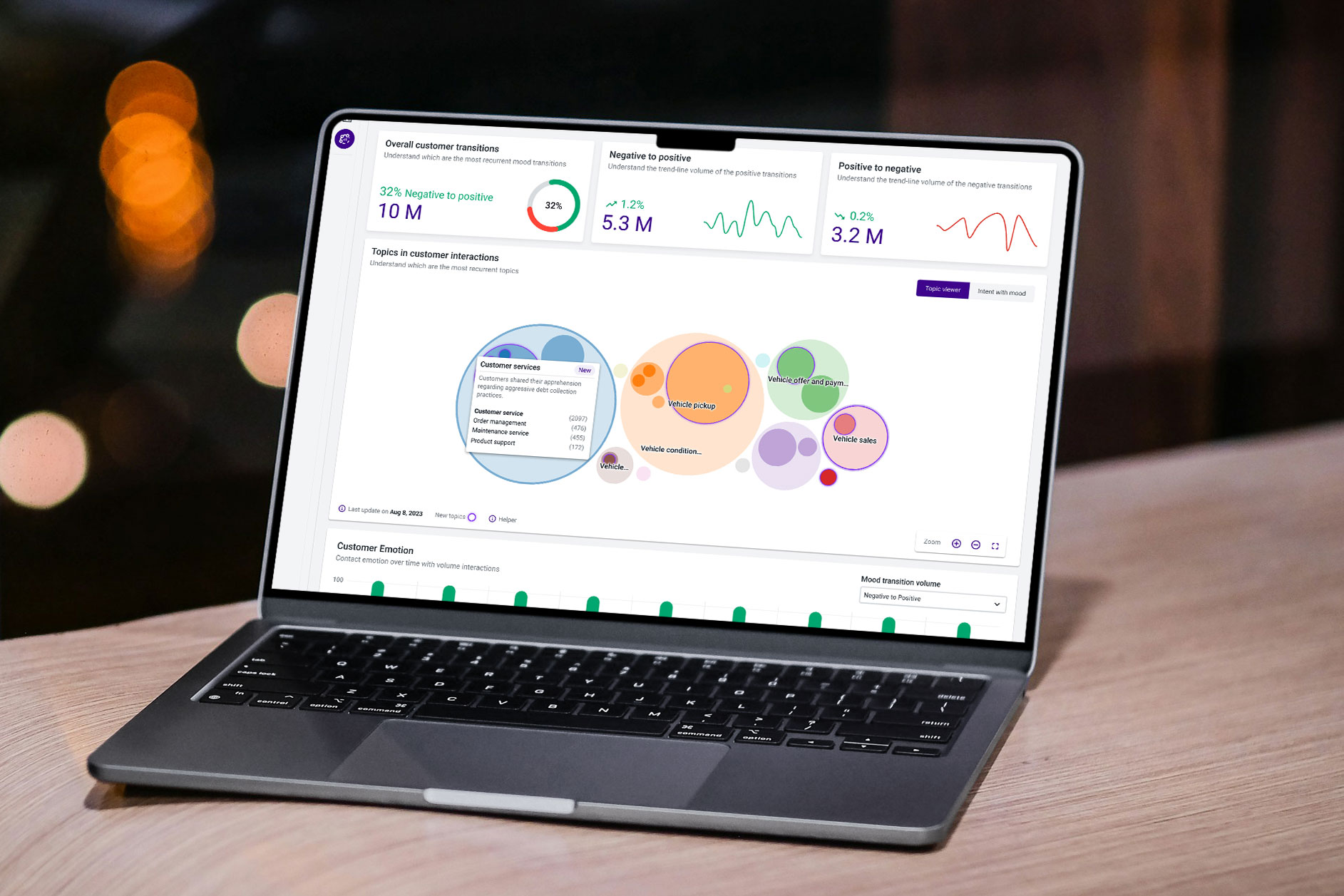
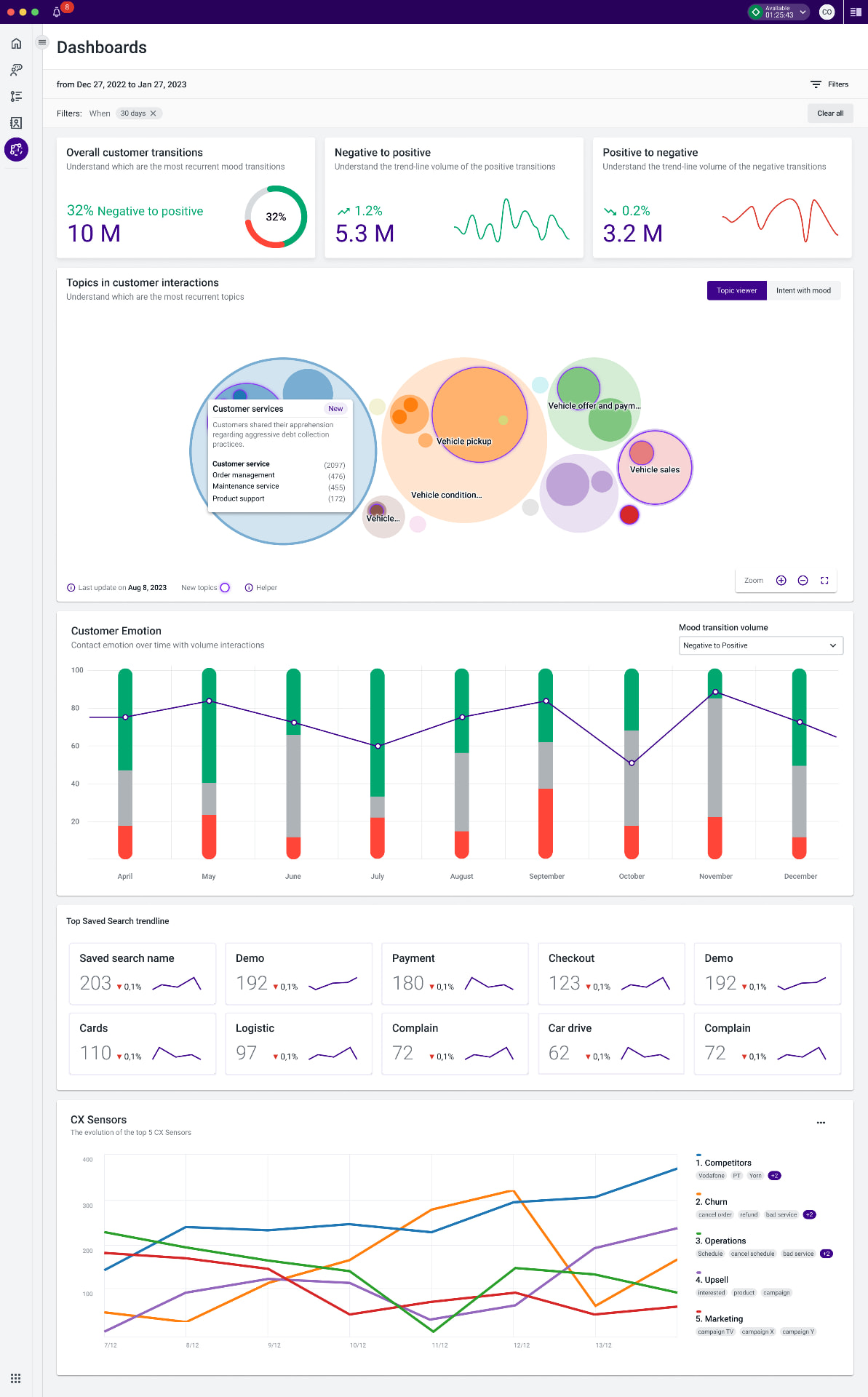
The dashboard opens with the question every manager asks first: are we turning conversations around? Overall customer transitions show how many interactions moved from negative to positive, and how many slipped the other way. Below, customer emotion is tracked month by month, so a change in conditions, a product launch or a new policy shows up as a visible shift, not a rumour.
- 01Mood transitions as the headline, so the direction of the operation is the first thing you see
- 02Emotion over time, so the impact of a launch or a change in conditions is visible the week it happens
- 03Saved searches with their own trendlines, so each team follows the questions that matter to them
Chapter 02 · Topics and intents
What customers talk about, and how it makes them feel
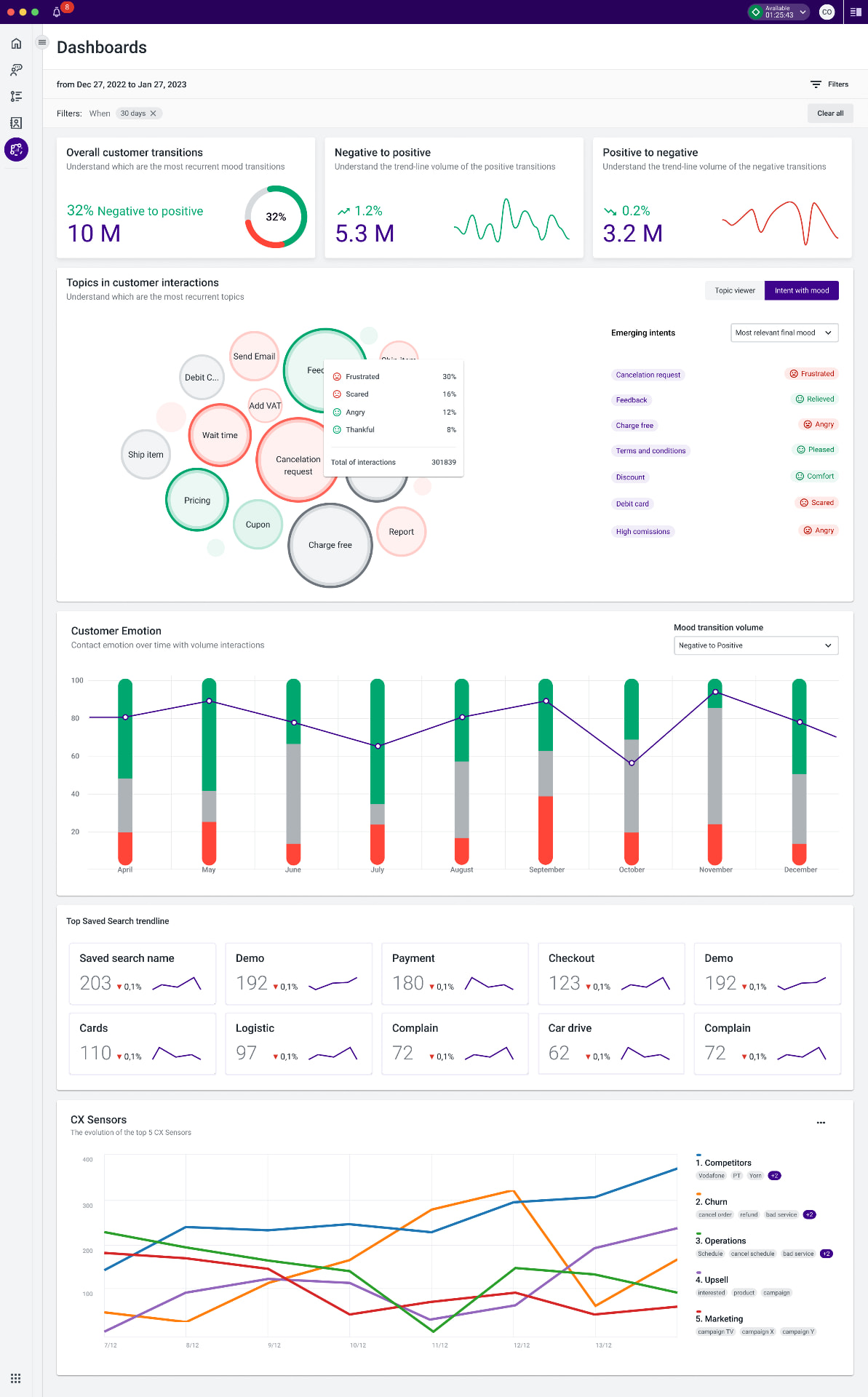
Topics appear as clusters sized by volume and coloured by mood, so the most prominent subjects and the ones turning sour are visible in the same glance. Switching to intent with mood reveals what customers were trying to do and the emotion each intent leaves behind, from cancellation requests that end in frustration to feedback that ends in relief. Emerging intents are listed on the side, so a competitor name or a new complaint is caught while it is still small.
- 01Clusters sized by volume and coloured by mood, so prominence and feeling read together
- 02Emerging intents surfaced early, including mentions of competitors
- 03CX sensors tracking churn, operations, upsell and marketing as their own trendlines
Chapter 03 · Evidence
From the chart to the exact conversation
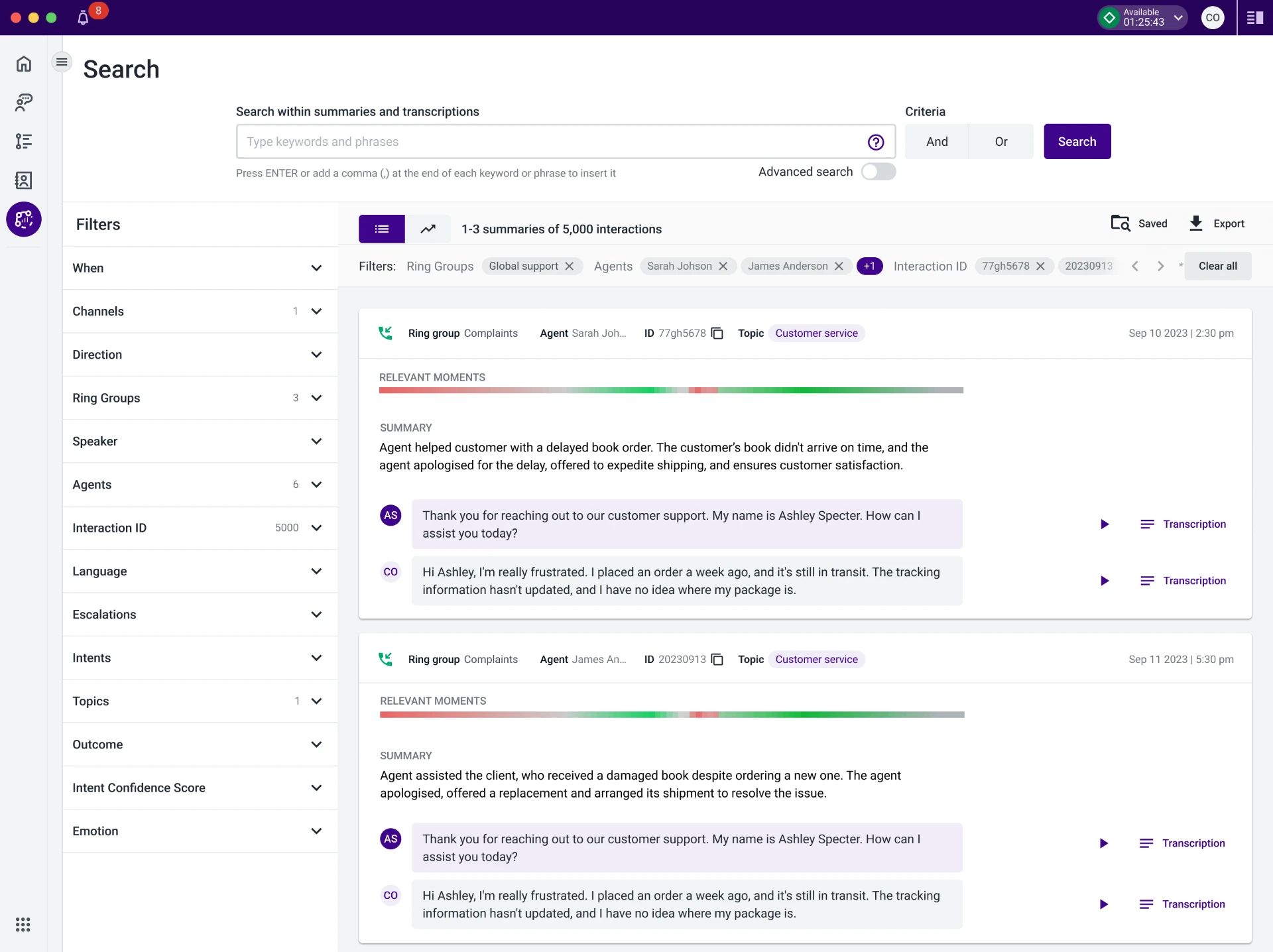
Every insight ends in proof. Search across summaries and transcriptions with filters for team, agent, topic, intent and emotion, and each result opens as a card: the relevant moments of the call on a timeline, a plain language summary, and the transcript one tap away. This is where coaching becomes concrete, where a team doing well becomes a mentor for the others, and where a decision about the business rests on what customers actually said.
- 01Filters for team, agent, topic and emotion, so each supervisor sees their own operation
- 02A summary and the relevant moments per call, so a review takes minutes, not hours
- 03The full transcript one tap away, so nothing has to be taken on trust
05. Key decisions
Mood transitions as the headline metric
Trade-offA harder model to build, but a number every supervisor understands without training.
Clusters instead of tables for topics
Trade-offLess precise at a glance, far better at showing what dominates and how it feels.
Saved searches as a daily ritual
Trade-offOne more concept to learn, but each team starts the day where its own questions live.
06. Outcome
Supervisors and managers run their daily routines on CXA: they spot the topics that need action, coach agents with real conversations, and recognise the teams that others should learn from.
What I learned
“Analytics is adopted when it answers the question people already ask every morning, and proves every answer with the conversation behind it.”
Next case
Making paid content as easy as a download